Infrastructure Elements
Examining the physical infrastructure that powers 5G networks in Oman
Physical Infrastructure Overview
The physical infrastructure of 5G networks represents the tangible hardware and facilities that enable wireless connectivity across Oman. This infrastructure spans the entire country, from urban centers to remote areas, and includes a variety of equipment and structures designed to provide reliable, high-performance connectivity.
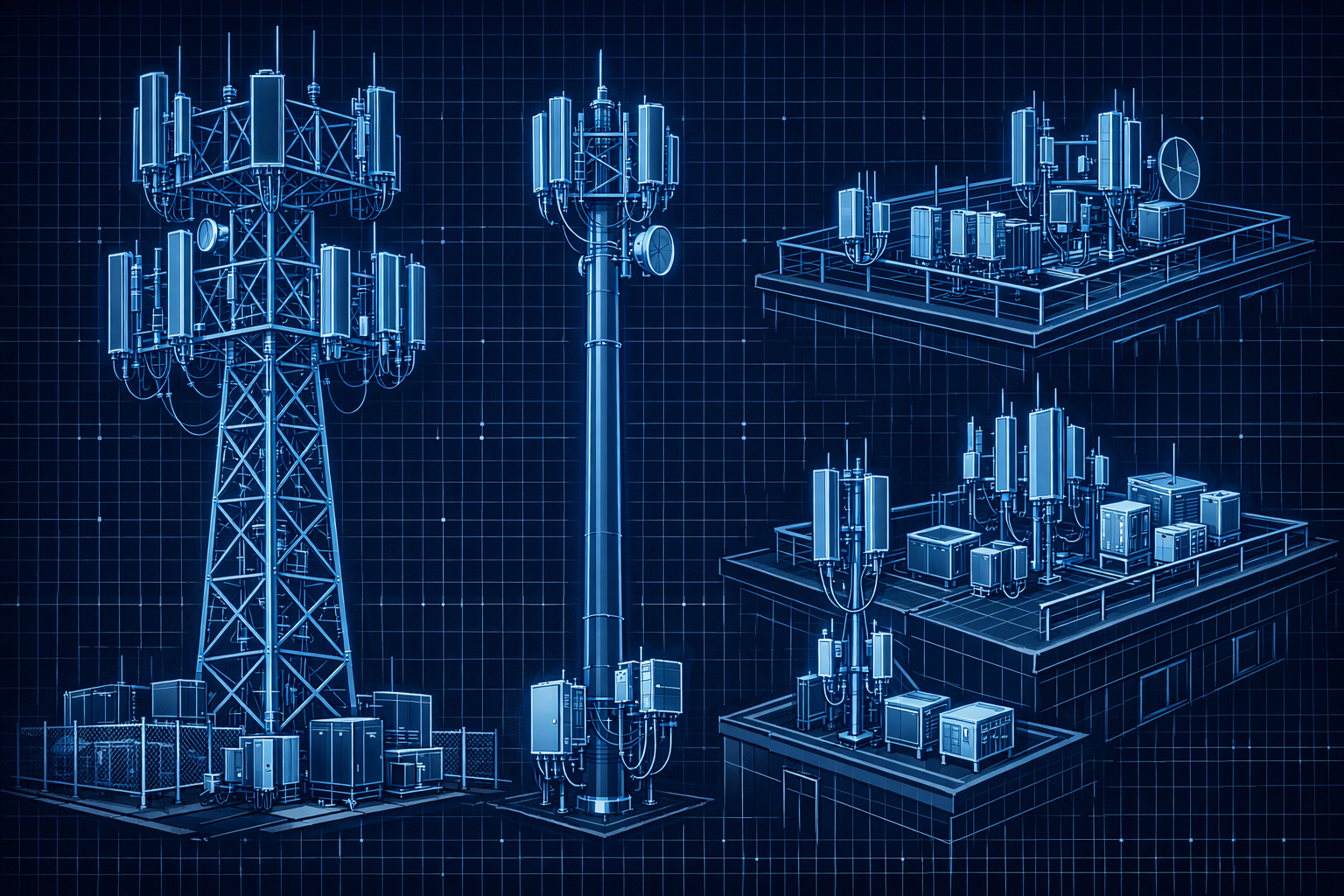
5G infrastructure builds upon existing mobile network infrastructure while introducing new elements and technologies to meet the enhanced requirements of next-generation services. The deployment of this infrastructure involves careful planning, engineering, and coordination to ensure optimal coverage and performance.
Communication Towers
Towers form the backbone of wireless infrastructure, providing the elevation necessary for antennas to achieve optimal coverage. 5G deployments utilize various types of towers, each suited to different deployment scenarios and environments:
Macro Towers: These tall structures, typically ranging from 30 to 100 meters in height, provide wide-area coverage in suburban and rural areas. Macro towers support multiple antenna arrays and can accommodate equipment for different frequency bands. In Oman, macro towers are strategically positioned to provide broad coverage across the country's diverse geography.
Monopoles: Single-pole structures that are more compact than traditional lattice towers. Monopoles are commonly used in urban areas where space is limited and aesthetic considerations are important. They can be designed to blend with surrounding architecture and are often preferred in residential and commercial developments.
Rooftop Installations: In dense urban areas, existing building rooftops are used to mount antenna systems rather than constructing new towers. This approach reduces visual impact and deployment costs while still providing the necessary elevation for effective coverage. Rooftop installations require careful structural assessment and consideration of wind loading requirements.
Concealment Solutions: To minimize visual impact, some towers are designed to blend with their surroundings. This includes towers disguised as trees, clock towers, or other architectural elements. In Oman's urban centers, concealment solutions help maintain the aesthetic character while providing necessary infrastructure.
Tower Sharing: Infrastructure sharing arrangements allow multiple operators to use the same tower, reducing the total number of towers needed and optimizing resource utilization. This approach is particularly important in environmentally sensitive areas or locations with limited available sites.
Transmitters and Radio Equipment
The radio equipment installed at tower sites performs the critical functions of transmitting and receiving wireless signals. This equipment has evolved significantly with 5G technology to support new capabilities and performance requirements:
Remote Radio Units (RRUs): These compact units contain the power amplifiers and radio frequency components necessary for signal transmission. RRUs are mounted close to antennas to minimize signal loss in feeder cables. In 5G deployments, RRUs support multiple frequency bands and advanced features like beamforming and massive MIMO.
Active Antenna Systems (AAS): 5G often uses active antenna systems that integrate radio functionality directly into the antenna array. This integration reduces passive inter-modulation, improves efficiency, and enables more sophisticated signal processing. AAS units are particularly important for mmWave deployments where signal loss is a critical concern.
Baseband Units (BBUs): Baseband processing equipment handles digital signal processing functions. In 5G architectures, baseband processing can be centralized at hub sites rather than distributed across every tower site. This centralization, known as Cloud RAN or C-RAN, enables more efficient resource utilization and better coordination between sites.
Power Amplifiers: High-efficiency power amplifiers are essential for converting baseband signals to radio frequency power for transmission. 5G equipment uses advanced amplifier technologies like GaN (Gallium Nitride) to achieve high efficiency and linearity, reducing power consumption and heat generation.
Filter Systems: Filters ensure that transmitted signals meet spectral requirements and prevent interference between different frequency bands. 5G deployments often use multi-band filter systems to support simultaneous operation across multiple frequency ranges.
Antenna Systems
Antennas are the interface between radio equipment and the air interface, converting electrical signals to electromagnetic waves and vice versa. 5G antenna technology has advanced significantly to support new capabilities:
Massive MIMO Arrays: 5G base stations deploy antenna arrays with dozens or hundreds of individual antenna elements. These massive MIMO systems enable beamforming, spatial multiplexing, and improved spectral efficiency. The large number of antenna elements allows the network to focus signals toward specific users and serve multiple users simultaneously using the same frequency resources.
Beamforming Antennas: Unlike traditional antennas that broadcast signals in all directions, beamforming antennas can focus energy toward specific directions. This improves signal quality, reduces interference, and extends range. Beamforming can be static, where fixed beam patterns are used, or dynamic, where beams are adjusted in real-time based on user locations and channel conditions.
Dual-Polarized Antennas: Modern antenna systems support dual polarization, effectively doubling the capacity by transmitting independent signals on orthogonal polarizations. This technique improves spectral efficiency and enables more users to be served simultaneously.
Multi-Band Antennas: To reduce the number of antennas required at tower sites, multi-band antennas can operate across multiple frequency ranges simultaneously. This simplifies deployment and reduces visual impact while maintaining performance across all supported bands.
Electrical and Mechanical Tilt: Antenna tilt can be adjusted electrically or mechanically to optimize coverage patterns. Electrical tilt allows remote adjustment of the vertical radiation pattern, while mechanical tilt requires physical adjustment. Proper tilt is essential for controlling coverage boundaries and minimizing interference between cells.
Supporting Infrastructure
Beyond towers, transmitters, and antennas, 5G networks require extensive supporting infrastructure to ensure reliable operation:
Power Systems: Reliable power is essential for continuous network operation. Tower sites are equipped with battery backup systems and often diesel generators for extended outages. Power distribution equipment ensures stable voltage and clean power supply to sensitive radio equipment. Solar power systems are increasingly used at remote sites to reduce operating costs and environmental impact.
Climate Control: Radio equipment requires controlled temperature and humidity for optimal performance and longevity. Tower sites are equipped with air conditioning systems, ventilation, and environmental monitoring to maintain suitable operating conditions. Passive cooling techniques are increasingly used to reduce energy consumption.
Security Systems: Physical security is critical for protecting network infrastructure. Tower sites are secured with fences, access control systems, and surveillance cameras. Security systems protect against unauthorized access, vandalism, and theft of equipment.
Fiber Connectivity: High-capacity fiber connections provide backhaul and fronthaul connectivity to tower sites. Fiber termination equipment, optical distribution frames, and network interface devices are installed at each site to manage fiber connections and ensure reliable data transport.
Monitoring Systems: Remote monitoring systems track site status, equipment health, environmental conditions, and power levels. These systems enable proactive maintenance and rapid response to issues, minimizing downtime and ensuring network reliability.